Patient leakage
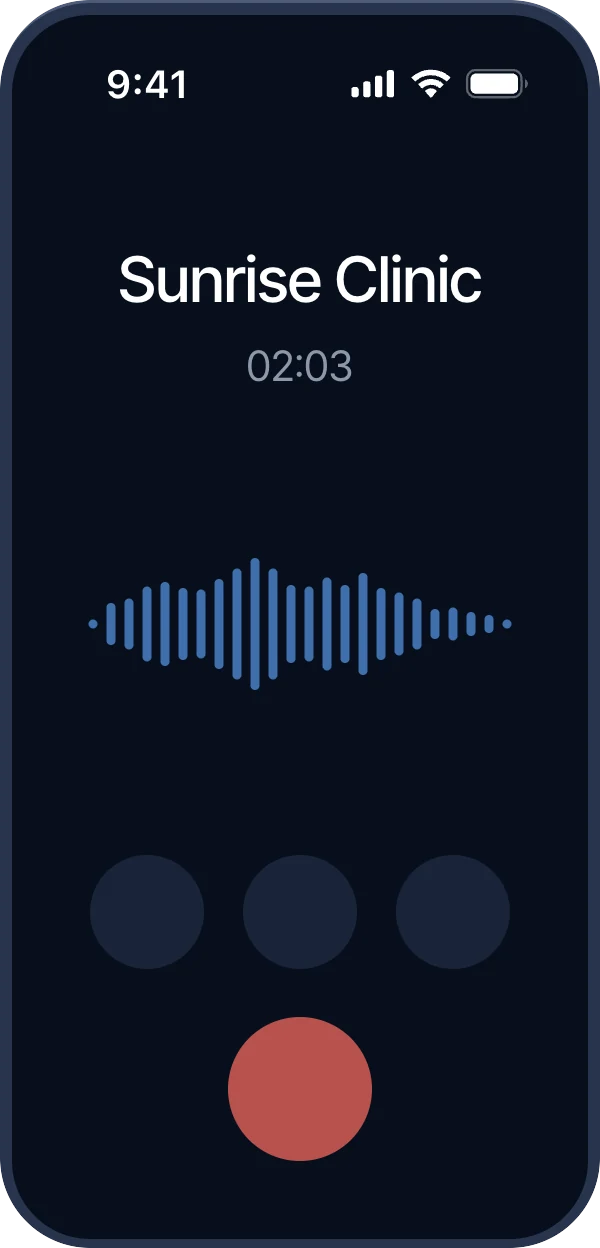
A patient calls to book.
Call unanswered. No callback.
Your hospital leaks patients, revenue and capacity, unseen.
We close it.
Connects agents to your systems, sets their context and permissions, and controls every action.
Broken by Design.
THE PROBLEM
Patient leakage
A patient calls to book.
Call unanswered. No callback.
Revenue leakage
Consumables used during care.
Usage never reaches billing.
Revenue leakage
The patient is ready for discharge.
Summary, pharmacy, billing and clearance wait on one another.
Nobody did anything wrong.
The work sat between people and disconnected systems.
THE PROBLEM
Nobody did anything wrong.
The work sat between people and disconnected systems.
Built to Execute.
THE SOLUTION
AI agents in your operations, run with you.
Clinical record
Patient channels
Operations
They connect, both ways, to the Airgent harness, where six AI agents work: Scribe, Front Office, Patient Flow, Revenue Cycle, Patient Relationship and Supply Chain.
The same agents, two ways in.
THE SOLUTION
We put AI agents to work in your operations and run them with you.
Your systems: the clinical record (EMR, HIS, lab), patient channels (phones, WhatsApp) and operations (billing, pharmacy, calendar).
They connect, both ways, to the Airgent harness, where six AI agents work: Scribe, Front Office, Patient Flow, Revenue Cycle, Patient Relationship and Supply Chain.
The work reaches your people: a patient is booked, a doctor signs a note, staff approve what needs a person, and management sees leaks closing.
The same agents, two ways in.
The agentic practice suite.
Agents built in

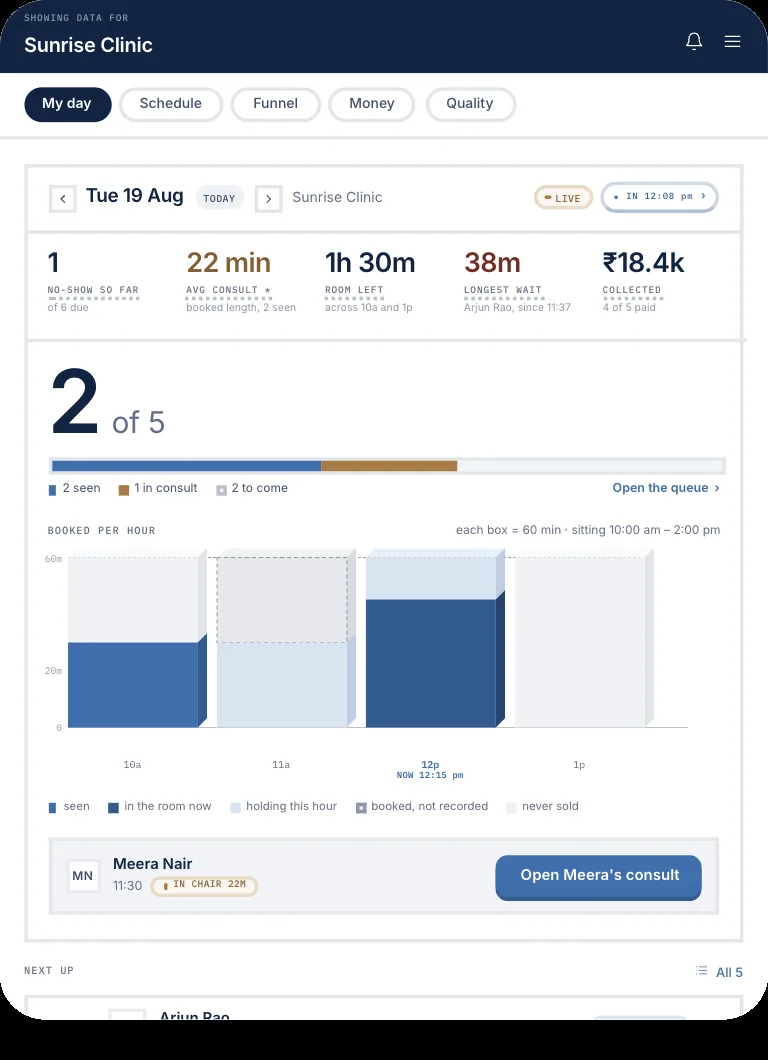
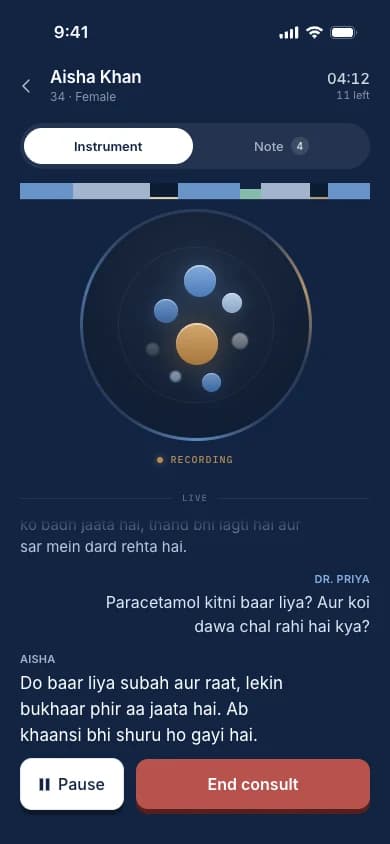
Your systems. Our agents. One harness.
How it works
The agent catalog
Six agents, one harness
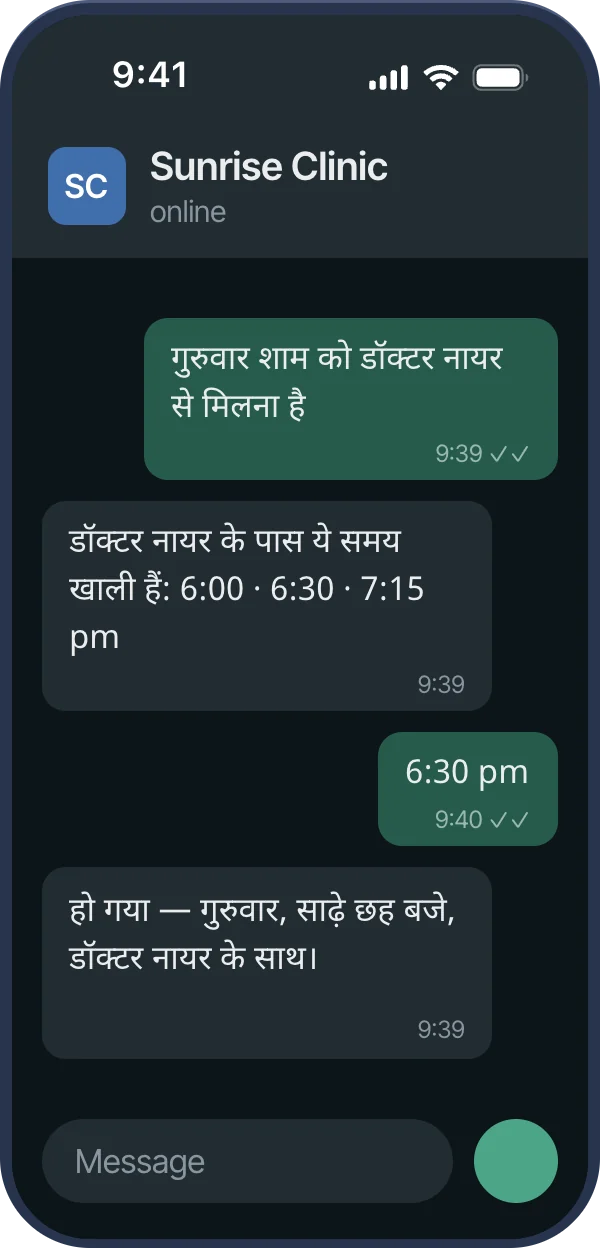
Your calendar
Meera Sharma · Dr NairThursday · 6:30 – 6:45 pm
Fitted, not Installed.
FORWARD DEPLOYMENT
Every organisation works differently, so every deployment starts with yours.
We sit with your team and find the leak
For example: six missed calls at the front desk, nine minutes without a callback.
We trace how the work runs today
The front desk's call log: missed calls with no callback.
We plan the fix, you approve it
The plan, answer every call the desk misses, approved by the clinic owner.
We connect it to the systems you use
The clinic phone line, WhatsApp and Google Calendar, connected.
It goes live with your team
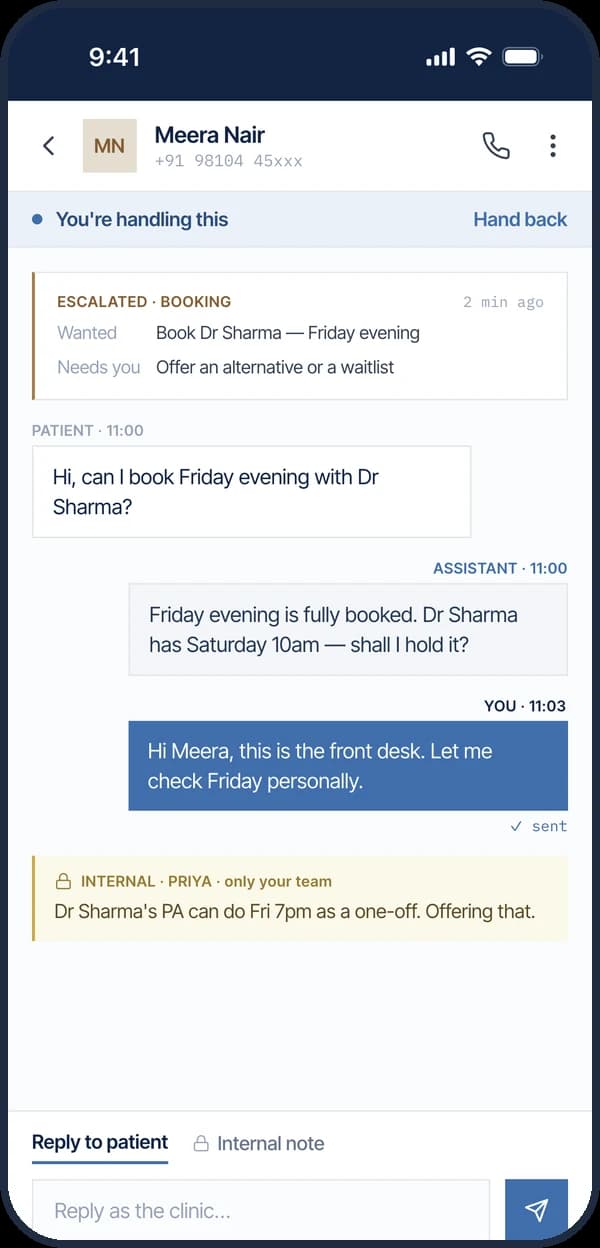
The patient gets a message from your clinic: booked for Friday, 11:00.
We measure, then close the next leak
Missed calls without a callback fall; the next leak is care given but never billed.
QUESTIONS
Pick your seat. See what matters in your seat, and what people in your seat ask us.
THE LEAK YOU FEEL
Revenue leakage
Money already earned that never reaches the account.
Closed by Airgent, for hospitals
Work that falls between desks: care given but never billed, a claim held on one missing document or a pending pre-authorisation, a bed empty for hours after discharge. The HIS records the work; people still carry it between systems, and it leaks in the gaps.
Each agent owns one process your team carries by hand today. Front Office answers calls and WhatsApp and books the slot. Scribe drafts the consultation note the doctor signs. Patient Relationship brings patients back when they are due. Patient Flow starts pharmacy, billing and the summary together at discharge. Revenue Cycle attaches the missing document before a claim stalls. Supply Chain raises the indent before the ward runs out. The Airgent harness connects each one to your systems and shows you every action.
Your SOPs become the agent's rules. In deployment we map how your team runs each process today (who books what, which cases need a doctor, when the desk steps in) and set those as the agent's rules and approvals in the Airgent harness. The agent follows them on every call and message; where a case needs judgement your SOP does not cover, it does not guess, it hands over to the person you named.
We sit with your team and find one leak, trace how the work runs today, and you approve the plan before anything goes live. Then we measure it and close the next leak.
No. The Airgent harness connects the agents to the systems you already run (your HIS or EMR, phones, WhatsApp, billing) and runs their work inside them. Your systems stay the record, and you see every action the agents take.
You do not have to take it on trust. The agents work inside rules you set, a person approves what matters, and you see every action they take. You start with one process and judge it on your own numbers before you add the next.
You pay for the work the agents do, not for another system to run. We start with the process where you lose the most, show the leak closing in your own numbers, and add the next process from there. The same agents already handle real consultations and patient calls in Keel, our own application.
THE LEAK YOU FEEL
Patient leakage
The work around medicine starts after the last patient leaves.
Closed by Airgent, and Keel for clinics
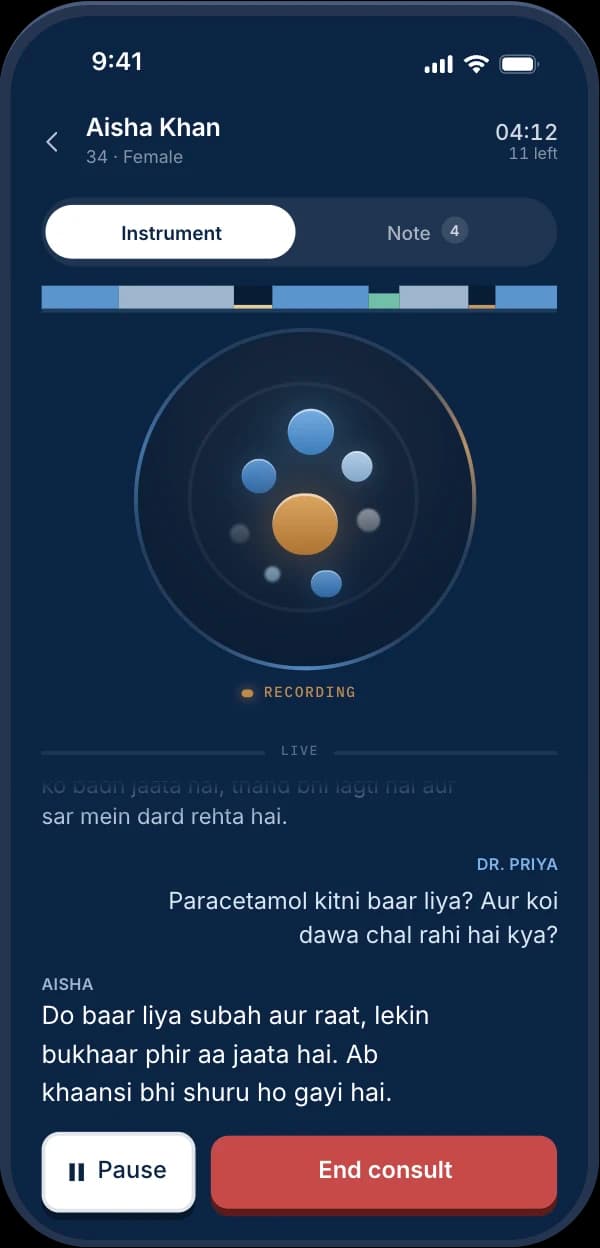
Paper works for the patient in front of you. It fails the patient you see next month: it cannot bring their history to you before they walk in, remind them when their review is due, or answer the call you missed mid-consultation. You keep consulting the way you do; the agents do the work paper leaves undone, and you still sign every note.
Before each visit, their past visits, reports and medicines come together in one view, so you start the consultation knowing what happened last time instead of asking the patient to remember.
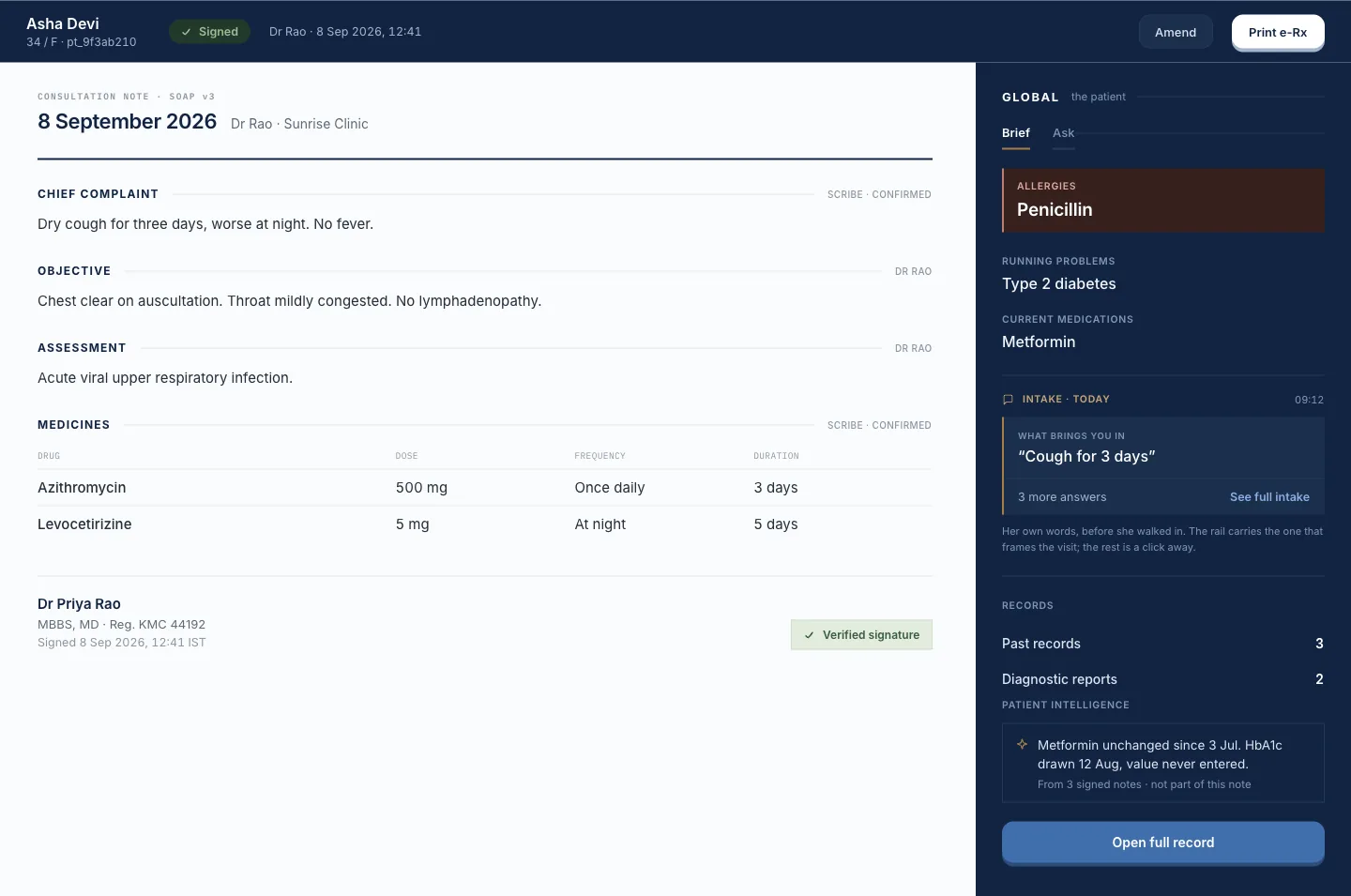
Yes. Ambient documentation listens to the consultation the way you speak, switching languages mid-sentence included, and drafts the note in your format. You read it and sign; nothing reaches the record until you do.
Yes. Every signed note, report and prescription joins the patient's record in one place, so each visit adds to a health record you read at the next one, instead of a new card every time.
The Patient Relationship agent reads what you said in the consultation (a review once the report is in, a repeat test, a change of medicine), reaches the patient when it is due, books the return, and tells your desk when someone does not respond. Continuity no longer depends on someone remembering.
The same as with a new colleague: you catch it, and it learns. Nothing clinical reaches the record until you sign, and when it is unsure it hands over to a person, so a mistake is caught before it reaches a patient. Every correction you make teaches it your words, your medicines and your way of working, so it gets them right the next time.
No. It takes the routine calls, WhatsApp messages and bookings, so your desk handles the patients who need a person, and your desk can take over any conversation.
Use Keel, our practice suite for doctor-run clinics, with the same agents built in. It is priced per doctor with the front desk free, and the agents charge only for the work they actually do.
WHAT STAYS WITH YOU
Your systems stay the record.
No. The agents work through your systems, not beside them, so your systems stay the record and there is no new silo to maintain.
Through the Airgent harness. It connects to the interfaces you already have (FHIR, REST APIs, MCP or webhooks, and RPA where there is no API), is fitted to your organisation by configuration rather than custom code, and puts every agent action through one gateway you can see.
Only named actions. Agents never touch your systems directly: every AI call passes one controlled gateway, and each organisation's data is walled off.
We do, as part of the deployment: we map your systems with your team, build the connection, and keep it running.
Run Keel, by Airgent: the application with the agents built in.
WHAT STAYS WITH YOU
Every action answers to you.
Agents never touch your systems directly. Every AI call passes one controlled gateway, limited to named actions, and each organisation's data is walled off from every other's.
Patient records are stored in India, and each organisation's data is kept apart from every other's in the database.
Yes. The patient's consent is recorded before a consultation is captured, their data is kept only as long as your retention rules say, and every access and action is logged, so you can show who saw what, and why.
Yes. The Airgent harness is modular: you choose the AI model behind each agent and where it runs, and you can change it without rebuilding the workflow.
You decide which actions need a person; those wait for approval before they run. Nothing clinical reaches the record until a doctor signs.
It is caught before it reaches a patient: anything clinical waits for a doctor, and anything uncertain goes to a person. Every run is recorded, so you can see what happened, and every correction your team makes teaches the agent, so the same mistake is not repeated.